
1. Introduction & Market Positioning
The wearable display landscape has reached a pivotal evolutionary milestone. For years, augmented reality (AR) glasses functioned primarily as niche productivity tools or passive media viewers, limited by low refresh rates, tracking latency, and poor software ecosystem integration. Hardcore gamers demanding desktop-level performance remained tethered to traditional physical monitors due to these technical limitations.
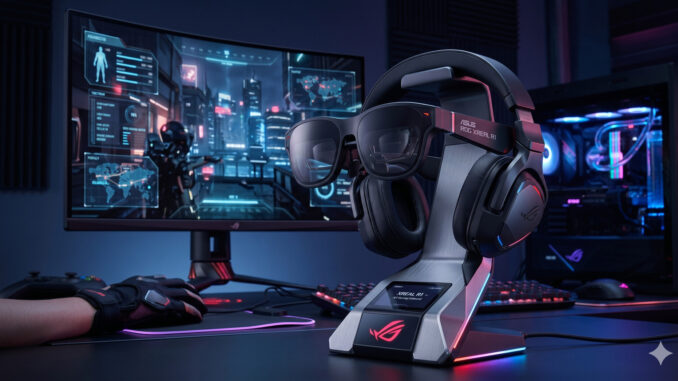
The ASUS ROG XREAL R1 Gaming AR Glasses completely disrupt this paradigm. Born from a high-profile strategic partnership between ASUS Republic of Gamers (ROG) and XREAL, the R1 is engineered specifically for competitive PC, console, and handheld players who refuse to compromise on visual fluidity or response times. Positioned at the premium apex of consumer spatial computing hardware, the ROG XREAL R1 bridges the gap between hardware-accelerated desktop monitors and hyper-portable head-mounted displays. It targets an uncompromising demographic: the modern enthusiast requiring a massive, high-speed virtual display for on-the-go deployment or advanced spatial multitasking configurations.
2. Hardware Architecture & Display Performance
Spatial Computing Driven by the X1 Chip Architecture
At the absolute center of the hardware array sits XREAL’s proprietary X1 spatial computing chip paired with the X-Prism Optical Engine. This customized silicon manages real-time IMU (Inertial Measurement Unit) data tracking and image projection pipelines directly on the device, dropping processing overhead on the host machine to zero.
+-------------------------------------------------------------+
|                     ASUS ROG XREAL R1                       |
|                 [91g Wearable Form Factor]                  |
+-------------------------------------------------------------+
                               |
                               v
+-------------------------------------------------------------+
|                    X-PRISM OPTICAL ENGINE                   |
|  - Dual Sony Micro-OLED Displays (1920 x 1080 per eye)      |
|  - 57° Field of View (FOV) | 106% sRGB Color Space          |
+-------------------------------------------------------------+
                               |
                               v
+-------------------------------------------------------------+
|                     CO-PROCESSING CORES                     |
|  - X1 Spatial Computing Chip (3DoF Engine & 3ms Latency)    |
|  - Hardware-Level 2D-to-3D Stereoscopic Pipeline            |
+-------------------------------------------------------------+
The underlying display hardware utilizes premium Sony Micro-OLED panels delivering a native Full HD (1920 x 1080) resolution per eye. By deploying Micro-OLED, the R1 achieves near-infinite contrast ratios with true, absolute blacks, eliminating the typical backlight bleeding that disrupts immersion in dark gaming titles like Resident Evil or Cyberpunk 2077. The panel covers 106% of the sRGB color gamut and pumps out up to 700 nits of peak brightness, delivering a highly saturated, punchy image even when operated in ambient daylight settings.
Breaking the 240Hz Barrier in Wearable Optics
The standout engineering milestone of the ROG XREAL R1 is its industry-first 240Hz ultra-high refresh rate. For context, previous consumer AR iterations topped out at 120Hz or 144Hz. By implementing an optimized Frame Rate Boost mode via advanced image scaling algorithms, the R1 delivers a blistering 240Hz display frequency with an instantaneous 0.01ms response time.
This ensures that high-speed motion blur, ghosting, and temporal artifacts are completely non-existent during intense competitive play. When tracking fast-moving targets in first-person ARPGs or countering oversteer in high-speed racing simulations, the spatial canvas remains perfectly crisp from edge to edge. The motion-to-photon latency is locked down to an astonishing 3ms, neutralizing the sensory disconnect that historically caused motion sickness in head-mounted monitors.
3. Ergonomics, Optomechanical Design & Thermal Management
Structural Weight Distribution and Long-Term Wearability
Engineering a high-performance monitor into an regular eyeglass chassis requires intense weight-saving discipline. The ROG XREAL R1 weighs exactly 91 grams, balancing the center of gravity perfectly across the bridge of the nose and the ears.
Unlike front-heavy VR headsets, the R1 utilizes a 3-level vertical temple angle adjustment system combined with customizable, multi-sized ergonomic nose pads. This allows users to fine-tune the display’s pitch angle relative to their optical axis, guaranteeing that text elements, HUDs, and UI parameters remain tack-sharp without forcing uncomfortable gaze angles.
Interpupillary Distance (IPD) Calibration & Prescription Integration
For optical precision, the R1 integrates digital Interpupillary Distance calibration. Users can double-tap the physical Menu button on the frame to bring up the On-Screen Display (OSD) Spatial Screen menu, allowing for modular software-driven IPD Adjustments. This micro-calibration ensures that stereoscopic imagery aligns accurately with the user’s natural pupil alignment, preventing eye strain during marathon play sessions.
+-----------------------------------------------------------------+
|               OPTOMECHANICAL CALIBRATION PIPELINE               |
+-----------------------------------------------------------------+
|  1. Physical Fit:    Toggle 3-level temple angle + nose pad sizes|
|  2. Optical Center:  Execute OSD-level digital IPD Calibration  |
|  3. Refraction Fix:  Drop in magnetic rx frames (Up to 1.67 index) |
+-----------------------------------------------------------------+
Furthermore, the unit is entirely prescription-ready out of the box. Every retail package includes an insert frame designed to accept custom-ground corrective lenses from local opticians, while pre-fitted high-index (up to 1.67) or blue-light blocking lenses can be ordered directly from authorized ecosystem partners.
4. Advanced Spatial Modes & Environmental Adaptability
Native 3DoF Control Engine
The inclusion of native Three Degrees of Freedom (3DoF) tracking changes how users interact with their screens. Driven by high-precision onboard IMU sensors, the R1 offers two fundamental viewing options:
- Anchor Mode: This locks the massive 171-inch virtual screen (projected conceptually at a 4-meter distance) into a fixed point in your physical room. When you turn your head to look away, the screen stays anchored in place, allowing you to view your physical surroundings, check peripheral devices, or monitor secondary desktop monitors seamlessly without taking the glasses off.
- Follow Mode: This mode employs smart dampening algorithms to smoothly transition the display along your field of view. It eliminates the violent, nauseating screen jitter characteristic of older wearable displays when walking or traveling in moving vehicles.
Complementing these features is the 360° Instant Sphere mode, which turns the wearer’s head into a dedicated camera controller for flight simulators and racing titles—allowing natural look-around tracking without touching a joystick.
Electrochromic Dimming & Auto Transparency Matrix
To maximize immersion across erratic environmental lighting conditions, ASUS and XREAL have implemented advanced Electrochromic Dimming technology. Via an integrated physical rocker on the arm, users can shift between three distinct tint levels manually, or toggle an intelligent Auto Transparency mode.
When Auto Transparency is engaged, the lenses instantly darken when you focus straight ahead on your game canvas, isolating your vision from outside visual clutter. The moment you look down or turn away from the core virtual screen boundary to check an external phone or keyboard, the lenses immediately drop their tint opacity. This creates a completely fluid transition between deep virtual reality immersion and physical spatial awareness.
5. Ecosystem Integration & The ROG Control Dock
Native Plug-and-Play Compatibility
The ROG XREAL R1 interfaces natively with Type-C devices supporting DisplayPort Alternate Mode (DP Alt Mode). It serves as a direct, zero-setup companion to the ROG Ally handheld series, drawing video feed and power over a single ruggedized Type-C cable. When paired with standard desktop rigs, the glasses interface with the comprehensive ASUS DisplayWidget Center software package, granting deep customization over color profiles, aspect ratios, and spatial anchoring parameters directly from Windows.
The Command Center: ROG Control Dock
For multi-device household setups, the included ROG Control Dock is a massive workflow improvement. Serving as a stationary signal switching hub, the dock hosts a robust selection of high-bandwidth input/output options:
| Port Type | Quantity | Standard Supported | Primary Target Use Case |
| HDMI Input | 2 | HDMI 2.0 | Next-Gen Consoles (PS5, Xbox Series X/S) |
| DisplayPort | 1 | DisplayPort 1.4 | High-End Desktop PC Graphics Cards |
| USB Type-C | 1 | DP Alt Mode Out | Direct ROG XREAL R1 Glass Connection |
A physical top-mounted button on the Control Dock allows users to alternate input sources on the fly. You can jump from a high-refresh PC competitive shooter setup directly over to a console role-playing session without swapping hardware cables.
6. Audio Architecture & Real-World Gaming Experience
Audio Engineering by Bose
Visual excellence requires an equally wide soundstage to achieve true immersion. The R1 features an integrated open-ear directional acoustic array tuned with Sound by Bose technology.
The custom acoustic drivers are embedded directly within the temples, focusing sound waves precisely into the user’s ear canals while cancelling outward leakage. The soundstage delivers spectacular positional audio. Environmental cues, distant gunfire, and subtle mechanical footsteps are tracked accurately across a simulated 3D space, providing competitive gamers with an immediate directional awareness advantage.
Instant 2D-to-3D Stereoscopic Conversion
For standard gaming libraries, the R1 houses an Instant 3D conversion engine. With a hardware-level calculation step, standard 2D video feeds are instantly upscaled into deep stereoscopic 3D layouts. This algorithmic injection adds a striking sense of scale, volumetric physical depth, and realistic distance rendering to traditional legacy games, giving your older game catalog an entirely fresh feel.
7. Comparative Performance Metrics
To truly evaluate the market standing of the ROG XREAL R1, it must be measured against alternative high-performance display configurations:
+-----------------------------------------------------------------------+
|                    REFRESH RATE & SPEED COMPARISON                    |
+-----------------------------------------------------------------------+
|  ROG XREAL R1:     ||||||||||||||||||||||||||||||||||||||||||  240Hz  |
|  Premium VR Head:  ||||||||||||||||||||                     120Hz     |
|  Standard AR:      ||||||||||||||||                         90Hz      |
+-----------------------------------------------------------------------+
When held up against traditional 240Hz desktop OLED monitors, the R1 matches their blistering frame delivery and pixel response times while saving an incredible amount of physical desk space. Compared to modern VR headsets, the R1 completely sidesteps the massive thermal footprints, heavy head straps, and closed-off isolation, providing a lightweight, breathable 91g alternative that lets you stay comfortably aware of your physical surroundings.
8. Conclusion & Final Verdict
The ASUS ROG XREAL R1 Gaming AR Glasses successfully cross the chasm separating conceptual spatial technology from true tournament-ready gaming hardware. By packing a stunning 240Hz Micro-OLED panel, near-zero pixel latency, responsive native 3DoF tracking, and a versatile multi-input Control Dock into a sleek 91-gram frame, ASUS and XREAL have crafted an incredibly compelling portable monitor alternative.
While the price tag is a serious investment, the R1 justifies its premium positioning by delivering flawless, high-speed visual performance that competitive enthusiasts can deploy absolutely anywhere. It is a triumph of spatial engineering and an absolute must-have for gamers looking to break free from physical display boundaries.